
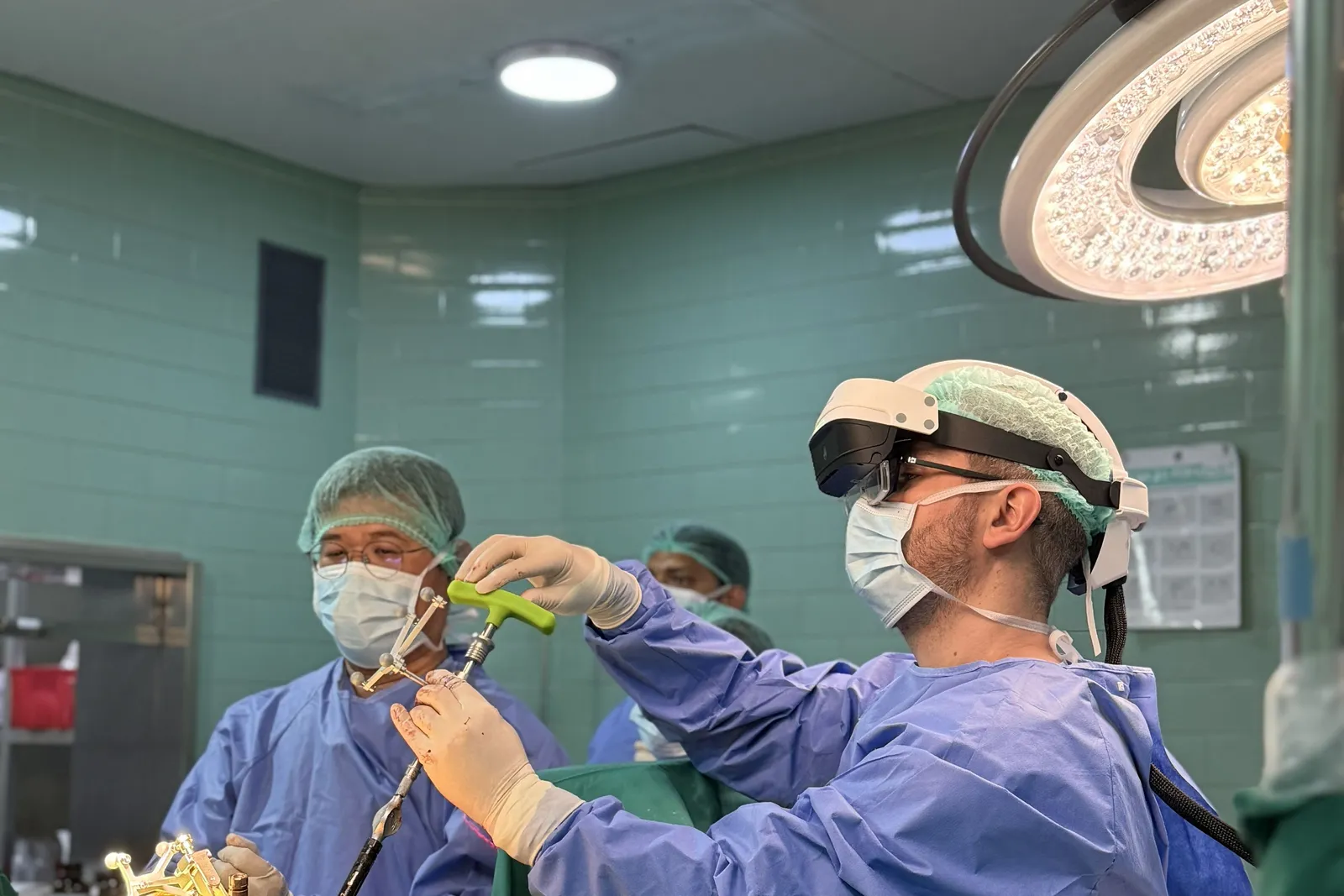
Medical Devices
Surgical technology that keeps your eyes on the patient
Three systems that cover the surgical workflow — plan the case, navigate inside the body, and see the image without looking away from the operative field. Developed by a team that spent more than five years in operating rooms before anything shipped.
The lineup
Three systems, one operating room
Each one solves a different part of the same problem: the surgeon needs spatial information, and needs it without turning away from the patient.
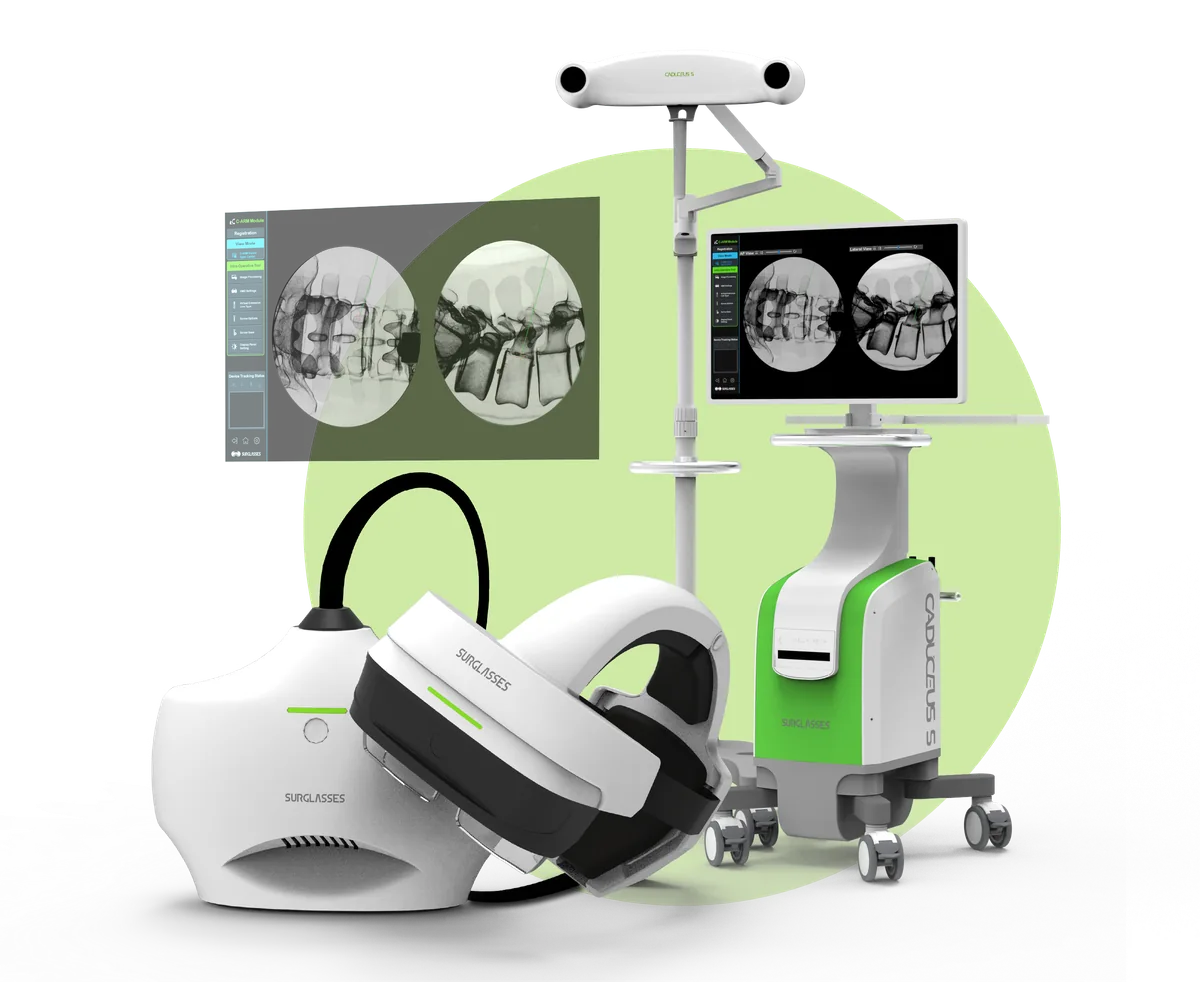
Caduceus S — AR Navigation
An image-guided navigation system for percutaneous spine procedures. A transparent near-eye headset lets the surgeon look at the patient and at the navigation images at the same time.
- Navigation on CT or C-arm images
- Posterior pedicle screw placement (FDA 510(k) cleared)
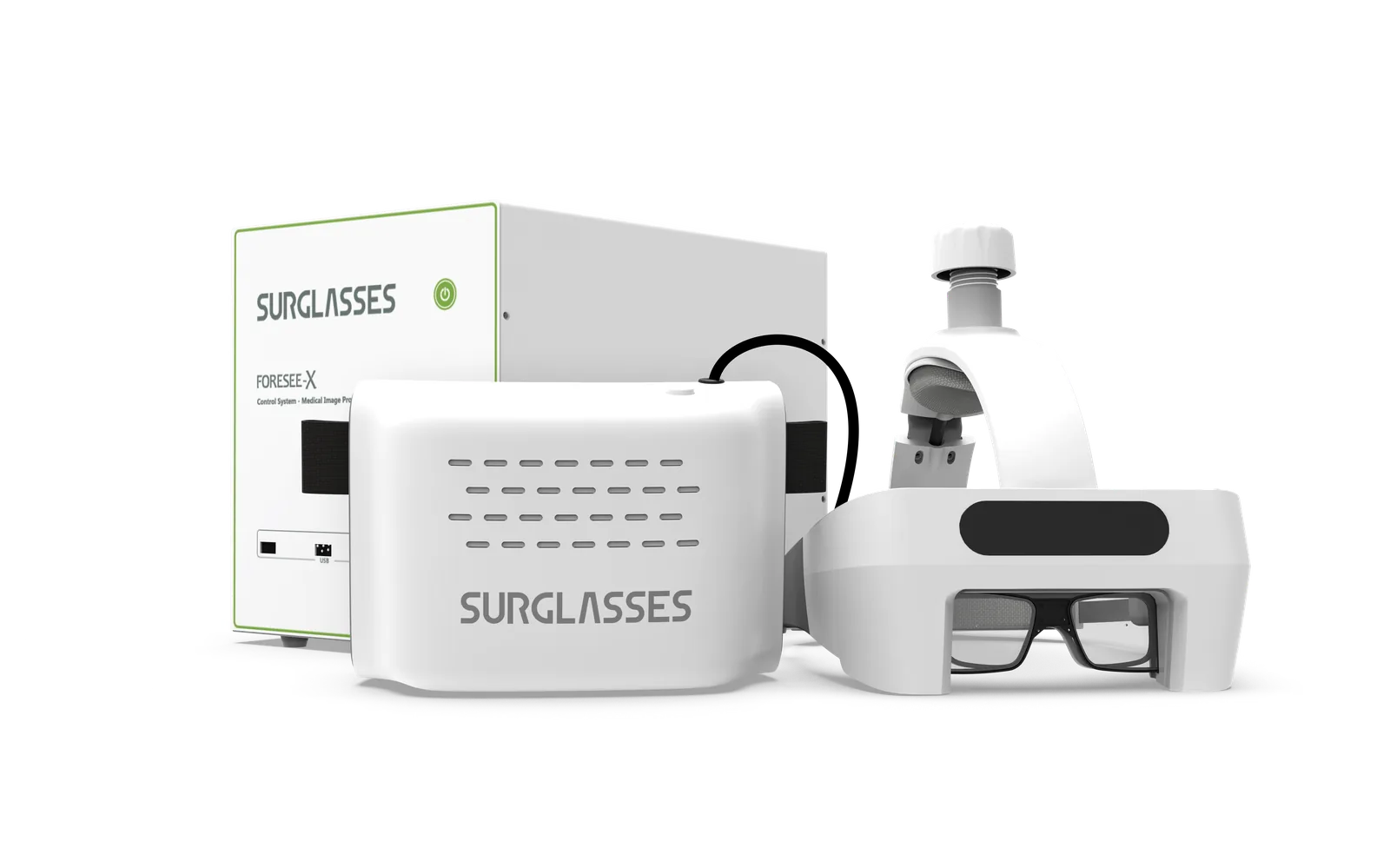
Foresee-X AR Glasses
A medical image display system. Signals from imaging equipment such as a C-arm, ultrasound or endoscope are shown on a headset worn by the user.
- Headset, control system and body-worn connection system
- Two signal sources at once; up to four headsets per control system
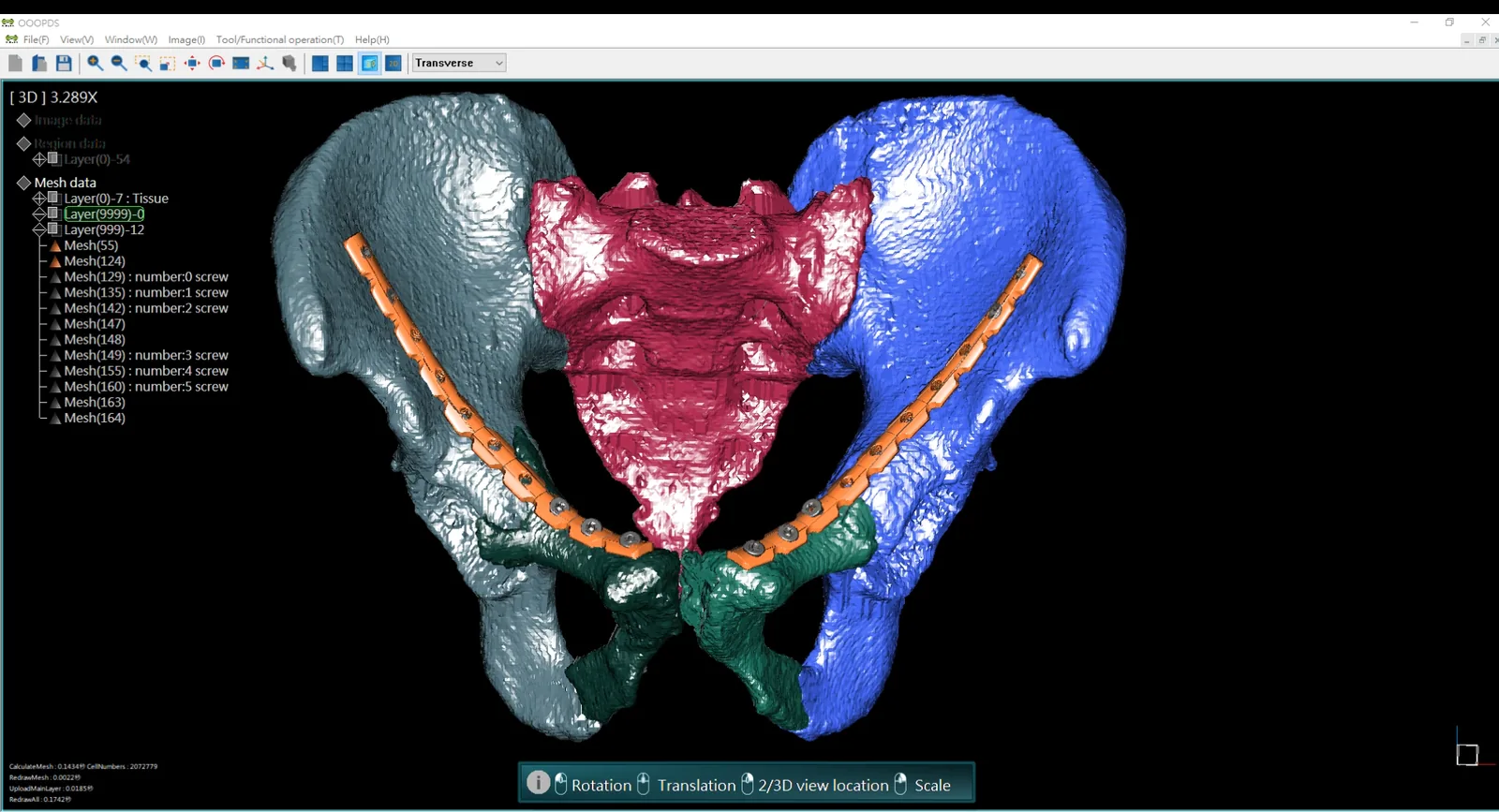
OOOPDS Surgical Planning
Orthopedic planning software developed entirely in Taiwan. It loads DICOM, rebuilds it as a true-to-scale 3D model, and lets the screws, punctures and plates be simulated before the first incision.
- Pedicle screw, SI screw and spinal puncture path simulation
- Patient-specific bone plates, exported as .stl, .ply or .obj to print
- Orthopedics, neurosurgery and dental implant planning
How they fit together
Plan it, navigate it, keep looking at it
The three systems are sold separately and each stands on its own — but they were designed around one continuous case.
Before the incision
OOOPDS turns the patient’s own CT or MRI into a 3D model, so screw diameter, length and trajectory are decided in advance — and a patient-specific plate can be 3D printed instead of bent by hand on the table.
Inside the body
Caduceus S shows the location of tracked surgical instruments relative to the patient’s acquired scan.
Without looking away
Both headsets show the image in the wearer’s line of sight instead of on a monitor across the room.
Regulatory status
Clearances and licenses
Every device below is a licensed medical device, manufactured under an ISO 13485:2016 quality management system certified by SGS.
Caduceus S
US FDA 510(k) clearances for Caduceus S: K220554 (opens in a new tab) (decision date 16 December 2022) and K242271 (opens in a new tab) (decision date 30 October 2024), plus a TFDA Class II license in Taiwan, MOHW-MD-No. 008401, and Thai FDA import license No. 66-2-3-2-0016533 issued in December 2023.
Foresee-X
CE marked as a Class I device under MDR (EU) 2017/745 for the European market, and licensed by the Taiwan Ministry of Health as a Class II medical device, MOHW-MD-No. 007801.
OOOPDS
Cleared by the US FDA under 510(k) K254214 (decision date 15 September 2026, product code LLZ). TFDA Class II medical device MOHW-MD-No. 007110 — 3D reconstruction and surgical planning software licensed by Taiwan’s Ministry of Health and Welfare.
See it for yourself
Find out which system fits your operating room
Tell us what imaging you already have and the procedures you run most, and we will show you the configuration that makes sense — online or on site.